The 4 Desk Mistakes That Are Stealing Your Energy (And How to Fix Them Today)
Stop blaming yourself for the pain. Your desk setup is probably wrong. These 4 ergonomic fixes work whether you have $0 or $1500 - and the 30-day plan means you'll feel relief in weeks, not months.
8/4/202610 min read
Ergonomic Workspace Setup for Chronic Pain
If you manage chronic pain, your workspace isn't just where you work, it's part of your treatment plan.
A poorly set-up desk can trigger flare-ups that derail your entire week. The right setup? It becomes invisible. You sit down, and your body just... works. No sharp lower back pain at 2 PM. No neck tension by the end of the day. No that-shooting-feeling-down-your-arm that makes you want to quit.
The good news: you don't have to choose between ergonomic and beautiful. In this guide, I'll walk you through exactly how to set up a workspace that supports your body AND looks like the kind of place you actually want to spend 8 hours.
Why Workspace Setup Matters for Chronic Pain
Your workspace is a biomechanical system. Everything is connected.
The cascade: Bad monitor height → forward head posture → tight shoulders → neck pain → tension headaches → flare-up → lost productivity → frustration.
Or: Proper chair height → neutral spine → shoulders relaxed → deep breathing → sustained focus → better pain management → actual life.
Most people don't realize how much of their daily pain comes from their desk setup. You might blame your condition when really it's your chair. Or your screen position. Or the way you're leaning.
The ergonomic approach isn't about buying expensive gadgets. It's about positioning your body so gravity works with you, not against you.
Four Ergonomic Workspace Foundation Pieces for Chronic Pain
Before we talk aesthetics, let's nail the functional foundation. These four things prevent pain:
1. Best Ergonomic Chairs for Chronic Pain & Rheumatoid Arthritis (The Most Important Investment)
Your chair supports your spine for 8 hours a day. A bad chair is like wearing shoes that don't fit for a decade, eventually it breaks you.
What to look for:
Lumbar support: should support the natural curve of your lower back (not flat, not exaggerated)
Seat depth: 16-18 inches; you should have 2-3 fingers of space between the seat edge and the back of your knees
Armrests: set so your elbows are at 90 degrees, shoulders relaxed (not hunched, not drooping)
Adjustability: height, backrest angle, armrest height all adjustable
Breathable fabric: mesh or fabric, not leather that traps heat (chronic pain + overheating = disaster)
Budget options:
👉 $150-300: Vonesse, TRALT, HOLLUDLE
👉 $300+: SIHOO
Aesthetic hack: Chair color matters. Neutral tones (charcoal, tan, soft grey) disappear into your space. Avoid racing-chair colors unless that's your vibe.


2. Desk Height & Surface
Your desk should position your elbows at 90 degrees when your shoulders are relaxed.
Standard height: 28-30 inches from floor to desktop
Test it: Sit in your chair. Let your arms hang naturally at your sides. Measure the distance from your elbow to the ground. Your desk should be at (or close to) that height.
Pro move: A standing desk or adjustable desk lets you alternate sitting and standing, which distributes load and prevents stiffness. Even switching every 60 minutes helps.
Surface aesthetic: A wooden desk (solid wood or quality veneer) feels better and looks better than particle board. Light wood (oak, ash, birch) pairs with warm tones. Dark wood (walnut) pairs with cool tones. Budget-friendly: IKEA Bekant or Pinnig.
3. Monitor Position (This Changes Everything)
This is where most people get it wrong.
The rule: Top of your monitor should be at eye level when you're looking straight ahead (not down, not up). Arm's length away (about 20-26 inches).
Why: If your monitor is too low, you hunch forward. If it's too high, you crane your neck back. Both → pain.
How to measure:
Sit in your chair in a relaxed, neutral posture
Look straight ahead
Your gaze should hit the top third of the screen
If you're looking down at your screen, it's too low (use a monitor stand or arm)
For laptop users: Never use a laptop as your primary screen. The keyboard and screen are too close together, forcing you to hunch. Use a laptop stand + external keyboard and mouse.
Aesthetic bonus: A monitor arm frees up desk space and looks sleek. A wooden monitor stand (or one that matches your desk) is both functional and beautiful.
4. Keyboard & Mouse Position
These should sit at the same height as your desk, with your elbows at 90 degrees.
Keyboard: Centered in front of you. Not angled, not reaching.
Mouse: Close to the keyboard, at the same height. A mouse that's too far away = constant reaching = shoulder tension.
Aesthetic choice: Mechanical keyboards (with wooden cases or minimalist designs) look good AND feel better to type on. A simple, ergonomic mouse in a neutral color disappears into your setup.
Making a Chronic Pain-Friendly Workspace Beautiful
Now that the foundation is solid, let's make it a space you actually enjoy.
Color Palette (Calming + Cohesive)
For chronic pain management, your workspace should feel calming. Overstimulation makes pain feel worse.
Recommended palette:
Base: Warm neutrals (cream, soft grey, tan, pale wood)
Accent: One soothing color (sage green, dusty blue, warm terracotta)
Accent 2 (optional): A natural texture (wood, linen, woven) for depth
Why this works: Neutral base = less visual chaos. One accent color = visual interest without overwhelm. Natural textures = grounding.
Apply it:
Desk: neutral wood
Chair: grey, tan, or cream fabric
Walls: soft white, cream, or pale grey
Accents: green plant, blue desk lamp, wooden storage
Lighting (Crucial for Pain Management)
Bad lighting causes eye strain, which causes tension headaches, which triggers flare-ups.
What you need:
Ambient light: Soft, diffused light (not harsh overhead fluorescents)
Task light: A desk lamp positioned to the side of your monitor, not shining directly at the screen
Natural light: Window nearby is ideal; if not, a full-spectrum bulb mimics daylight
Aesthetic + functional: A wooden or brass task lamp (not a harsh desk lamp) provides light while looking intentional. Warm-toned bulbs (2700-3000K) are easier on the eyes than cool white (5000K).
Pro setup: Warm ambient light + warm task light + monitor blue light filter (built into most devices) = minimal strain.
Greenery & Texture
Plants do two things: they improve air quality (subtle but real) and they're visually calming.
Low-maintenance plants for a desk:
Pothos (trails beautifully, barely needs water)
Snake plant (thrives on neglect, sculptural)
Rubber plant (statement plant, easy care)
Pilea peperomioides (trendy, does well in indirect light)
Placement: On a shelf behind your desk, or on a small plant stand in the corner. Creates depth without cluttering your workspace.
Texture adds coziness:
A linen desk pad (protects the desk + adds softness)
A small woven basket for cable management (mess hidden, visual organization)
A wood desk organizer or ceramic pencil holder


The "Cozy Corner" Setup (Optional but Powerful)
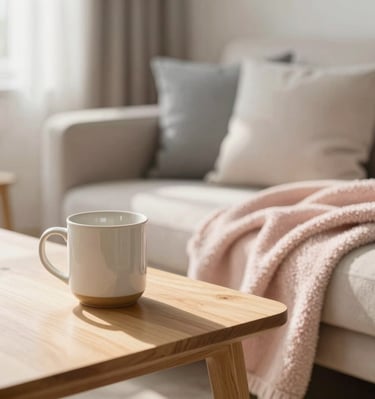
If you have the space, a small cozy corner near your workspace creates a physical reset point for breaks.
What goes there:
A comfortable chair or cushion (different from your work chair)
A small side table (for tea, water, a book)
A soft blanket or throw
A lamp (warm light)
Why it works: When pain flares mid-work, you can move to this corner, change positions, breathe, and return to work. It's a reset button that doesn't require leaving your workspace.
Real-World Setup Examples
Budget: $0-200 (Optimize What You Have)
👉 Use your current chair but add lumbar support (a small pillow, $20-40, https://amzn.to/4yQChH7)
👉 Raise your monitor with a stack of books or a DIY stand
👉 Reposition your desk so the window light hits from the side
👉 Add one plant in a pot you already own
👉 Rearrange to create a cozy corner with furniture you have
Time to implement: 2 hours
Budget: $200-500 (Good Fundamentals)
👉 Chairs with surprisingly good ergonomics: Vonesse, TRALT, HOLLUDLE
👉 Monitor stand ($30-50) https://amzn.to/3Ub549n
👉 Desk lamp ($50-80) https://amzn.to/3RQOevL
👉 Small shelving unit for plants + storage ($60-100) https://amzn.to/3ScgPvN
👉 Desk pad + organizer ($30-50) https://amzn.to/4bXZxZW
👉 Plant(s) ($20-50) so many to choose from and all personal taste
Total: ~$400-500
Time to implement: 4 hours
Budget: $500-1500 (Solid Setup)
👉 FLEXISPOT standing desk ($300-500)
👉 COLAMY office chair ($300-400)
👉 VIVO premium monitor arm ($80-120)
👉 NEATFI quality task lamp ($100-150)
👉 GARVEE shelving or storage ($100-150)
👉 Plants + decor ($50-100) again, all personal taste
Total: ~$1000
Time to implement: Full day
The Chronic Pain Adjustment: Know Your Limits
Here's what I've learned: some days your setup needs to change. On high-pain days, your tolerance is lower. You might need:
A heating pad behind your lower back (change position mid-morning)
Extra lumbar support (even if you don't usually need it)
Shorter work blocks (25 min work, 5 min move break)
Permission to recline the chair more than usual
A stool to rest your feet on (elevates, reduces pressure)
Permission slip: Your workspace doesn't have to be perfect every day. It has to be adjustable.


30-Day Implementation Plan
Week 1: Assess & Plan
Photograph your current setup
Identify what's causing the most pain
List what needs to change (priority order)
Budget and research options
Week 2: Foundation
Get your chair situation sorted (new chair or supportive addition)
Adjust monitor height and keyboard position
Add task lighting
Week 3: Aesthetics
Bring in plants, colors, and texture
Organize cables and desk surface
Set up your cozy corner (if applicable)
Week 4: Refine & Adjust
Live with it for a week
Adjust what doesn't feel right
Build your "high pain day" backup setup
By end of month: A workspace that supports your body, looks intentional, and makes you want to sit down.
The Bottom Line
Chronic pain management isn't just about medication or treatment. It's about designing your life so pain doesn't get the upper hand.
Your workspace is where you spend 8+ hours a week (for many, much more). Get this right, and you remove a daily source of flare-ups. You create a space where your body can relax and your mind can focus.
You deserve a workspace that doesn't hurt you. Let's build it.
What's Your Biggest Workspace Challenge?
Have you already made changes to your workspace?
I'd love to hear what worked for you.
👉 Join our email community and tell me what you've done to make your workspace easier.
Frequently Asked Questions
Can an ergonomic workspace setup actually reduce chronic pain?
Yes, significantly. Your workspace is a biomechanical system-poor alignment creates compensatory tension that accumulates over 8 hours. A proper setup (neutral spine, shoulders relaxed, no forward head posture) removes that daily strain. Most people notice improvement within 1-2 weeks of adjustment. It won't cure your condition, but it can reduce pain severity by 20-40% just by removing a daily aggravating factor.
What's the ideal desk height for someone with chronic pain?
28-30 inches from floor to desktop is the standard, but your ideal height depends on your arm length. Sit in your chair with good posture, let your arms hang naturally at your sides, and measure from your elbow to the ground. Your desk should be at that height so your elbows are at 90 degrees when you're typing. If you're shorter or taller than average, this matters-don't force yourself into a standard height that doesn't fit your body.
Should I get a standing desk if I have chronic pain?
A standing desk alone isn't the answer-it's the switching that helps. Staying in one position (sitting or standing) for 8 hours creates stiffness and pain. A standing desk that lets you alternate sitting and standing every 60 minutes distributes load and prevents the cumulative strain of all-day sitting. If budget is tight, a regular desk works fine if you're willing to take movement breaks every hour.
How should my monitor be positioned if I have chronic pain?
Top of your monitor at eye level, arm's length away (about 20-26 inches). Your gaze should hit the top third of the screen when looking straight ahead. If your monitor is too low, you hunch forward (→ neck and shoulder pain). If it's too high, you crane your neck back (→ neck and upper back pain). This is one of the highest-impact adjustments you can make. If you use a laptop, get an external monitor and keyboard-laptop-only setups force you to hunch.
What's the best ergonomic chair for rheumatoid arthritis?
Look for: lumbar support (supports your lower back's natural curve), adjustable armrests (so your elbows are at 90 degrees), breathable fabric (not leather-heat makes pain worse), and seat depth of 16-18 inches (so you're not sitting on the edge or too far back). Budget options ($150-300) like Vonesse or TRALT work well. Higher-end chairs ($300+) like SIHOO add more customization. Test if possible-what works for one person's RA might not work for another's.
How often should I move or change positions if I have chronic pain?
Every 60 minutes minimum. Get up, walk, stretch, change positions. On high-pain days, every 30 minutes. Movement prevents stiffness, resets your nervous system, and prevents the "pain creep" that happens when you're static. Your workspace should support this: a cozy corner nearby where you can sit in a different position, move around, and reset. It's not a sign of weakness-it's part of the setup.
Can plants and lighting really help chronic pain?
Indirectly, yes. Bad lighting causes eye strain, which causes tension headaches, which triggers flare-ups. Warm-toned lighting (2700-3000K) + a monitor blue light filter significantly reduces strain. Plants and greenery are visually calming, which helps your nervous system relax-chronic pain is partly neurological, so a calming environment reduces your baseline pain level. It's not a cure, but these details matter over 8 hours.
What's the budget to set up a workspace for chronic pain?
You can start with $0-200 (optimize what you have: add lumbar support, raise your monitor, reposition your setup). A functional setup runs $200-500 (good chair, monitor stand, task lamp, plants). A solid, complete setup is $500-1500 (standing desk, premium ergonomic chair, monitor arm, quality lighting, storage). Start small, adjust, and upgrade over time. Don't wait for the perfect $1500 setup-a $200 adjustment today beats a $1500 setup "someday."
I have a high-pain day. Should I change my setup?
Absolutely. Your workspace doesn't have to be perfect every day-it has to be adjustable. On high-pain days, you might need: extra lumbar support, a heating pad, a more reclined chair position, or shorter work blocks (25 min work, 5 min movement). Build flexibility into your setup. If your chair only has one position, you're fighting your body. If your desk is too rigid, you're stuck. Adjustability is more important than perfection.
How long does it take to see results from workspace ergonomics?
Most people notice a difference within 1-2 weeks. By week 4, it becomes obvious (you realize you didn't have that 3 PM pain spike). If you don't notice improvement after a month, something isn't dialed in correctly-usually monitor height, chair height, or lumbar support. Adjust one thing at a time so you know what's actually helping.
Live well,
Krista
Affiliate Disclosure: Some links in this post are affiliate links, meaning I may earn a small commission if you purchase through them at no additional cost to you. I only share products that I personally believe provide genuine support and comfort for those living with rheumatoid arthritis and chronic illness.